2026-07-08
My prompting framework
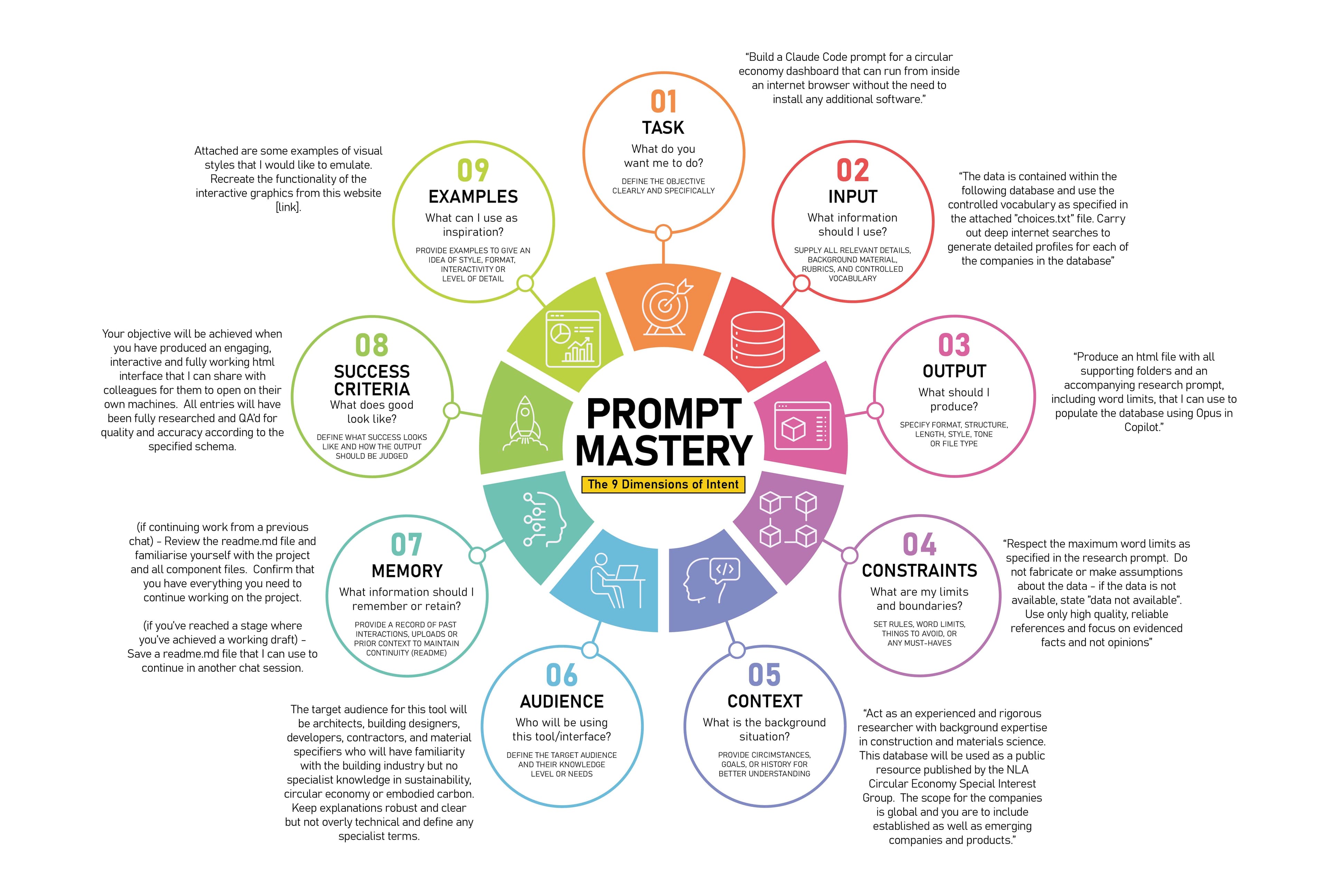
One of the biggest lessons I've learned from using AI is that the quality of the response is often determined long before the model starts generating an answer. A well considered prompt sets up a very good foundation for getting good results.
The infographic below distils the nine dimensions of intent for prompting: the key ingredients that transform a vague request into a clear brief that an AI can genuinely work with.
Rather than simply telling an AI what you want, effective prompting provides context around:
- The task – what are you trying to achieve?
- The input – what information should be used?
- The output – what format should the response take?
- Constraints – what rules or boundaries must be followed?
- Context – why is this being done?
- Audience – who is the end user?
- Memory – what previous information should be retained?
- Success criteria – what does good look like?
- Examples – what should the result emulate?
The framework is simple, but surprisingly powerful. Whether you're building a dashboard, researching companies, drafting a report, analysing data, or creating content, these nine dimensions help reduce ambiguity and improve the quality, consistency and reliability of AI-generated outputs.
What I find particularly useful is that the framework mirrors how we would brief a colleague or consultant. We wouldn't simply say, "Create a report." We'd explain the purpose, the audience, the information available, the constraints, and how success will be judged. AI is no different.
As AI becomes embedded in more professional workflows, prompt writing is emerging as a valuable skill in its own right. It's less about learning clever tricks and more about learning how to communicate intent clearly.
The better the brief, the better the outcome.
And perhaps the most important takeaway? If you're not getting the results you want from AI, the solution is often not a different model—it's a better prompt.